We tried to run The Timberline on email and apps alone. Guests kept falling through the cracks. Here’s what we learned about why text works — and when a phone call still matters.
When we opened The Timberline, we had a vision for how guest communication would work: fully contactless, message-based, no phone calls. Guests would use an app or email us if they needed anything. Clean, modern, scalable, and manageable for our small team.
We operated without a phone for the first eight months we were open. And honestly, I’m not proud to say that.
We learned a lot in that first year — neither my husband nor I had worked in hospitality before. But a major lesson was the reality that guests need support. Real support, sometimes at inconvenient hours, in ways that email was never built to handle. And what we found — pretty quickly — is that when we made it easy for guests to reach a human, the whole experience got better. For them and for us. When you run a hospitality company, you are hosting all the time. You can make it as contactless as you want, but you’re still hosting, and guests are going to experience however helpful or unhelpful you are.
One of the first changes we made was moving from email as the primary channel to text, and it made a world of difference in our operations and guest experience almost immediately.
The open rate problem everyone feels but nobody talks about
Email open rates in hospitality hover around 20%. SMS open rates are 98%, according to LoungeUp. The average email takes 90 minutes to open. The average text takes 90 seconds.
If you’ve ever sent a guest their check-in instructions by email and then gotten a call an hour later asking for the door code, you’ve felt that gap. The email went out. It was probably sitting in a promotions folder. For anything time-sensitive — door codes, parking instructions, early check-in confirmation, a heads-up that their room isn’t ready — email is a gamble you’re constantly losing. Text is a near-certainty.
Guests are already texting
Americans send and receive texts at five times the rate of phone calls, according to SMS research compiled by Notifyre. Texting isn’t a preference people developed for hotels — it’s how they communicate with everyone.
When a guest texts your hotel number and gets a response in a few minutes, it doesn’t feel like a technology choice. It feels like good service. When they have to find your email address, compose a message, and wait, it feels like friction.
90% of customers say they prefer text messages over phone calls for business communication. Your guests already know which one they’d rather use. The question is whether you’ve made it easy for them to do it.
What we actually use text for
At The Timberline, text handles most of what used to go through email:
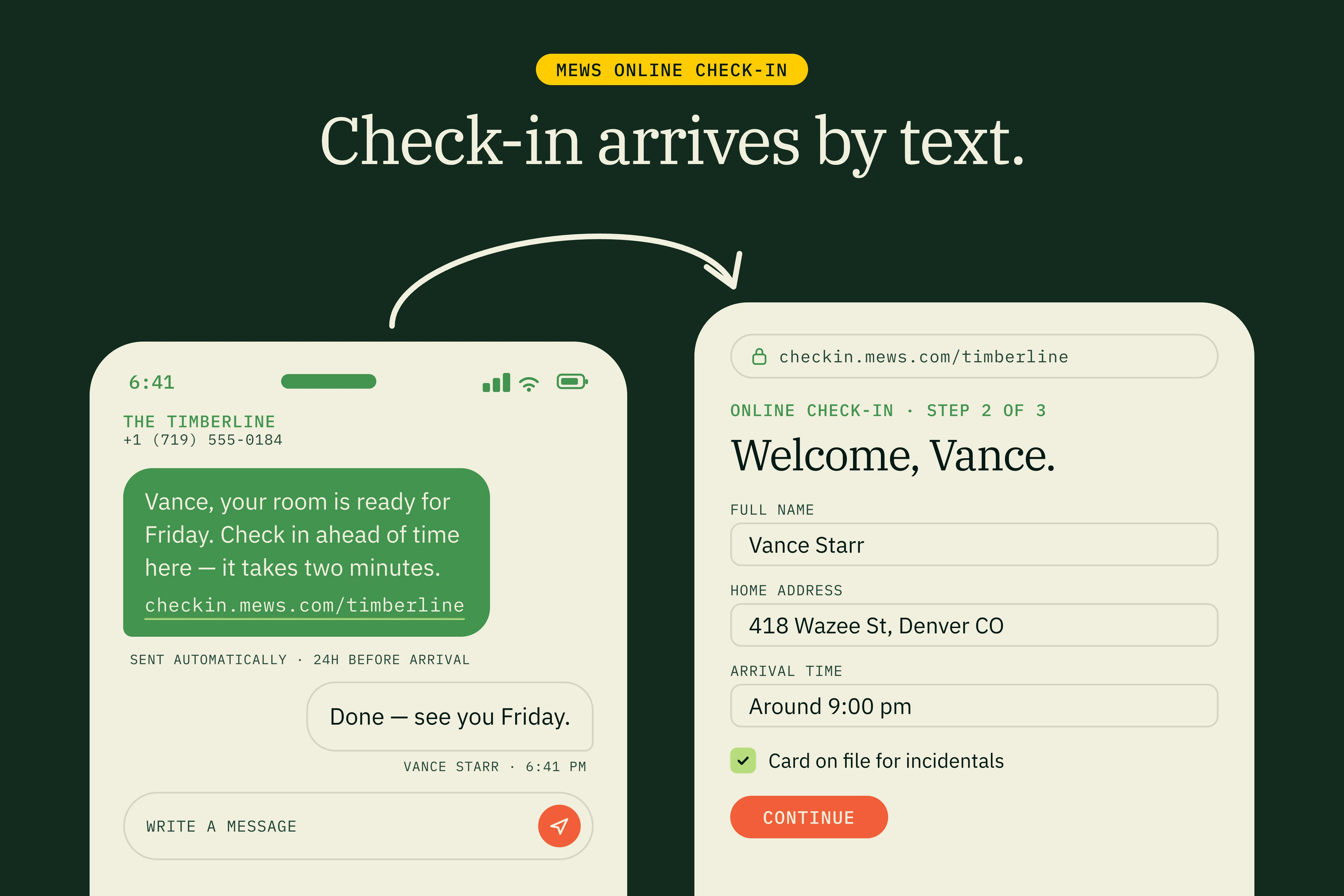
Pre-arrival: Door codes, parking info, check-in time confirmation. Guests are usually driving or traveling when this matters most — a text they can glance at is useful. An email they’ll read later isn’t.
Mid-stay requests: Extra towels, late checkout requests, questions about local restaurants. These used to come in through whatever channel the guest happened to find first. Now they come through one place.
Small issues: A noisy neighbor, a question about the thermostat, something that isn’t quite right. Guests are much more likely to text a small problem than call or email about it. Which means we catch things earlier and fix them before they become a review.
We moved to text partly because of delivery and open rates with email. Text also lacks the formality of email — it’s faster for both parties and feels like a conversation, which sets the stage for a genuinely good guest relationship. Because of that, our guest contacts increased significantly once we made it easier to reach us.
Most hotels would see that as a problem. More contacts means more work, more team time. But that thinking misses something: guest problems don’t disappear just because guests don’t tell you about them. If you care about the experience, you need an open line of communication. What you want isn’t fewer contacts — it’s better tools to handle them.
When a phone call still matters
Still, there are moments when text isn’t the right tool. If a guest is locked out of their room at 11pm, they’re calling. They should call. That’s an urgent situation and they want to hear a human voice.
Same if something is genuinely wrong — a real complaint, something that needs to be resolved, a situation where tone matters. Text can come across as dismissive when a guest is frustrated. A call changes that.
We also get a lot of guests who call while they’re driving. They’re on their way and they want to ask about check-in time or directions. That’s not a text conversation — they’re in the car.
The goal isn’t to eliminate voice. It’s to give guests options to reach you however works best for them — and to make it manageable for your team regardless of how that contact comes in. We do that by keeping voice and text in one place, with guest context attached to both. One system, not two.
The one number that ties it together
The biggest shift for us wasn’t choosing text over email. It was pulling everything — calls, texts, voicemail — into a single number.
Before, guests had to guess how to reach us. Some called. Some emailed. Some messaged through the OTA platform they booked on. Whoever was working that day checked whatever they happened to check.
Now there’s one number. Guests call it or text it. Everything comes through one shared inbox that anyone on the team can see. A guest who texts at night gets a response from whoever’s on, and when I check in the morning, the whole conversation is there.
That’s not a complicated system. But it’s a different one than most small hotels are running.
If email — or worse, your app — is still your main channel, the problem isn’t that guests aren’t checking it. It’s that they’ve moved on, and the inbox is the last place they’re looking. Stop making guests work so hard to reach you, and they just might want to keep in touch.